
Chem 201L Organic Chemistry: Research Tips
Effective Search Strategies
Many library databases use keyword searching. Rather than asking a question in the search bar, we need to break our quiery into its main concepts, which become our search terms or keywords during our search. Taking a few minutes to think about our topic and its related keywords before we begin searching can save us time during the search process.
Developing keywords
Try breaking down your question into it's basic parts.
Example Search: What are the impacts of social media on college student's mental health?
Keywords: Social Media, College, Mental Health
Think of Synonyms
Think of different ways to describe your keywords. Other authors may not use your exact words when writing about your topic. What are some other words that someone might use to discuss your idea?
| Keywords | Related Terms |
|---|---|
| Social Media | TikTok, Instagram, Facebook, YouTube, Snapchat |
| College | University, Higher Education, Undergraduate Students |
| Mental Health | Mental Illness, Depression, Anxiety |
The video below will demonstrate effective searching in two of our go-to database picks for Kinesiology research (Health Source and MEDLINE Ultimate, both hosted by EBSCO).
Using Scholarly Resources - Science Databases
Created by librarians at Santiago Canyon College Libraries, this video explains:
- How to select promising articles from a results list
- How to identify when articles are both on-topic and relevant to the project at hand
- How to evaluate articles for information important to your research
Created by librarians at Johns Hopkins' Sheridan Libraries, this video explains:
- (at 3:18) Structure and sections of scholarly articles in social sciences and sciences
- (at 6:28) Structure and sections of scholarly articles in the humanities
- (at 7:09) Strategies for reading scholarly articles
- (at 8:03) Reading and note-taking tips for scholarly articles
A student might meet with a librarian to discuss:
- Finding Resources: To get help locating books, articles, and other materials relevant to their research topic.
- Research Strategies: To learn effective search techniques and strategies for navigating databases and online resources.
- Citation Assistance: To receive guidance on properly citing sources and citation management strategies.
- Evaluating Sources: To get tips on assessing the credibility and relevance of sources.
- Narrowing Topics: To refine or narrow down a broad research topic into a more manageable scope.
- Developing Research Questions: To get help formulating strong, researchable questions.
- Using Library Services: To learn how to use specific library services, such as interlibrary loan.
Academic Search Ultimate is a database we subscribe to from EBSCO, and we strongly recommend the use of this database for academic research.
Created by librarians at Clovis Community College Library, this video explains:
- How to search in Academic Search Ultimate
- Options for accessing articles within the databases
For additional information on how to find what you need quickly, run an advanced search (even if you don't feel like an advanced user!), and save and organize your searches from EBSCOhost: How to Search EBSCO Databases
Created by librarians at Wilfrid Laurier University Library, this video explains:
- The benefits of turning a topic into a research question
- How to narrow a general topic into an inquiry of appropriate scope
- How to isolate important variables using the questions: Who? What? Why? When? How?
Elements from a strong research question can be used as search terms in later steps in this process.
Scholarly articles? Peer-review?
You will be expected to know these terms and use these materials as part of your academic coursework, but what do they mean and how are you expected to use them?
Librarians from Wayne State University have created an excellent "crash course" to explain these concepts, which are key to completing successful academic research.
Generating Search Terms
A mind map is the visualization of a subject and its related concepts. For example, if you were going to write a paper on Fashion History, you would need to narrow it down. Using a mind map, you could visualize it's sub-topics until you found a good fit. These sub-topics can serve as a good starting point for your keyword searches.

There are several free tools online for creating a mind map, but sometimes it is easiest to use pen and paper!
-
Mindmup.comYou can use this free service to create a mind map of your own.
-
Browsing & Searching Cited ReferencesSome EBSCO databases provide the ability to "browse references." When you run a Basic or Advanced Keyword Search, any Cited References or Times Cited in this Database links that are available are presented with your search results.
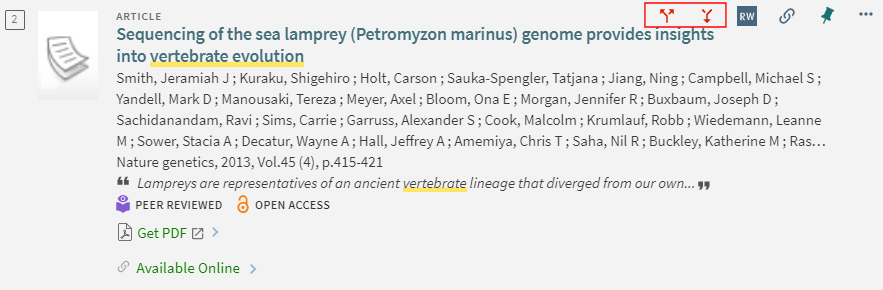
Found in the library catalog, Citation trails is an exploration tool that helps to find related articles and to a topic further by showing both articles cited by and cited in the current article.
Sections of a Scientific Paper
Scientific papers are structured documents used to share original research with the scientific community. Most scientific papers follow the same formula and typically include the following sections.
- Abstract
- Introduction
- Materials and Methods
- Results
- Discussion
- Conclusion
- References
This guide offers a quick overview of each of the sections, along with tips for writing your own scientific papers.
The abstract is a brief summary of your paper. It should be descriptive enough that another fellow scientist can review this section and understand your study’s purpose, methods, key findings, and conclusion without reading the full paper.
When writing an abstract make sure to include:
- Background information and objective of your study (state your hypothesis)
- A brief description of your methods, including the study type, sample size, and specific techniques.
- Key results of your study, especially statistically significant findings.
- A summary of your conclusion and weather your hypothesis was supported
Tips:
- Be concise! Most abstracts are roughly 250 - 500 words
- Focus on your methods and results
- Write it last, after the rest of your paper is complete
- Avoid jargon and vague language
- Make sure it stands alone and doesn’t repeat the introduction
The introduction explains why your research matters and how it fits within existing scientific knowledge. It sets the stage for your study and leads into your hypothesis.
When writing an introduction make sure to include:
- A brief review of relevant literature
- A clear explanation of your research question or problem
- Why your topic is important and how it relates to previous work
- Your hypothesis stated near the end
Tips:
- Use the present tense
- Be clear and concise
- Clearly state your objectives
- Refer to key studies that support your topic
The materials and methods section is used to describe how you conducted your study so that other scientists can replicate your study. Be detailed and systematic in your explanation.
When writing a materials and methods section make sure to include:
- Your experimental design and procedures
- The materials and equipment used
- Description of subjects or samples, including recruitment and selection processes
- Data collection methods and measurements
- Statistical analysis tools used
Tips:
- Use the past tense
- Be precise and direct
- Include enough detail to reproduce your study
- Organize your information in a logical order
The results section is used to describe your experimental findings. This section should only include your direct observations, data, and statistical significance of your results. Do not include any interpretations of the data.
When writing the results section be sure to include:
- Sample size and demographics (n=...)
- Results of statistical analysis (p=..., Std. Dev.)
- Key observations from your experiment
- Relevant charts and figures visualizing your data
Tips:
- Use the past tense
- Present your results in a logical sequence
- Only present your data, avoid any interpretation or citations
- Ensure all visuals are labeled and understandable on their own
The discussion section is used to interpret your data and explain their significance. It connects your findings (results section) with your hypothesis and broader scientific context (introduction).
When writing the discussion section make sure to include:
- Interpretation of key results and statistical figures
- Whether your hypothesis was supported or rejected
- Relevance of your findings to the existing research
- Possible explanations or limitations of your findings
- Suggestions for future research.
Tips:
- Remain focused on your study and avoid over generalizing your results
- Compare your results with other relevant research
- Include relevant references
- Only make conclusions that are directly supported by your results
- Use clear and concise writing
Some papers include a separate conclusion section, while others combine it with the discussion. The conclusion section wraps up your paper and emphasizes the importance of your findings to the larger scientific context.
When writing the conclusion section, make sure to include:
- A brief summary of your study
- Restate your hypothesis and whether if was supported by the data
- Address any limitations of your study
- Suggest new avenues of research or future areas of study
Tips:
- Be concise and confident in your writing
- Focus on your findings and their significance
- Avoid introducing new information
- Do not summarize your entire paper, focus on the key takeaways
Scientists do not work in a vacuum of knowledge, rather all science is built off of the work of others. The references section credits the sources you used and shows how your work fits into the broader scientific conversation.
A reference section should include:
- Citations for every source referenced in your paper
Tips:
- Only included sources cited in your text
- Alphabetize your list
- Use a consistent citation style
- Double check your reference list for accuracy and proper formatting prior to submission
Library Home | Library Admin | Alma | Worldshare Admin | Mobile Site